Keywords
How to Cite
Abstract
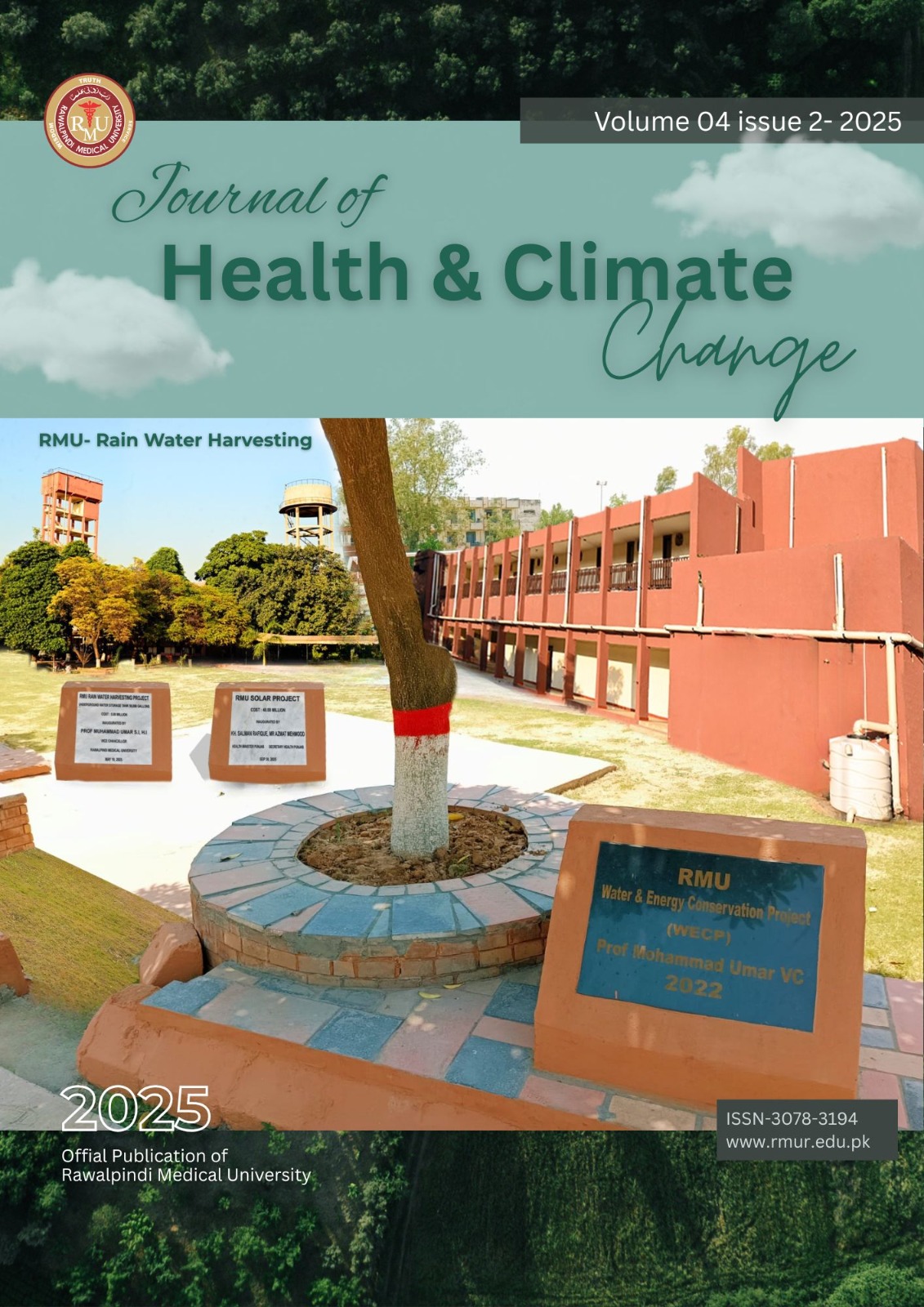
Rapid urbanization and expansion of higher education institutions have significantly altered land-use patterns, often at the cost of environmental sustainability. Universities, as centers of innovation and public leadership, have a responsibility to adopt eco-friendly campus planning models. This study presents a comprehensive assessment of the covered and uncovered area matrix of Rawalpindi Medical University (RMU), Pakistan. Using systematic spatial measurement and categorization, the campus land was divided into built-up areas, open concrete spaces, and green zones including grassy lawns and tree-covered areas. Results demonstrate that approximately 62.5% of the campus is under concrete coverage, while nearly 35% is reserved for green and ecological purposes. The findings highlight RMU’s progress toward a green campus model while identifying opportunities for further optimization in line with international sustainability benchmarks.

This work is licensed under a Creative Commons Attribution-ShareAlike 4.0 International License.
Copyright (c) 2026 Azhar Mehmood, Tayab Ahmed Ali, Sarah Rafi, Sadia Ahmed